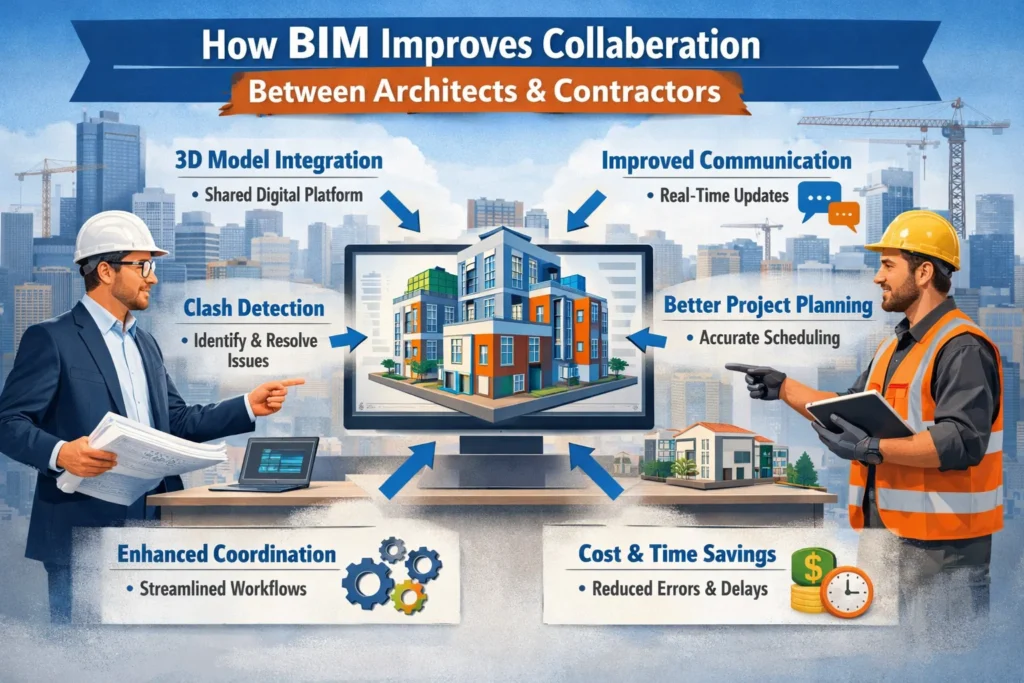

Construction collaboration improves when the people designing the building and the people building the construction are looking at the same data. That sounds easy; however, in practice, it’s miles one of the hardest parts of a challenge. Different document versions, overdue layout modifications, uncertain quantities, and mismatched assumptions can turn a truthful task into a pile of RFIs and alternate orders. BIM has become beneficial because it provides each aspect with a common virtual space to work from. Research and requirements work point to the equal concept: BIM improves collaboration, scope control, and price control when the model is established nicely and shared well.
Why collaboration improves when the model becomes a shared language
BIM Modeling Service helps architects and contractors speak in the same data language instead of trying to decode each other’s drawings and markups. The National BIM Standard says the BIM Use Definitions module exists to provide a common framework and consistent terminology, along with the inputs and outputs that define a BIM use case. That matters because collaboration breaks down when one team thinks in plans and another thinks in quantities, sequence, and cost. A defined BIM framework reduces that mismatch.
The same BIM framework additionally helps more than geometry. A 2023 overview observed that BIM features support assignment management knowledge areas, including scope, cost, time, finance, communications, procurement, danger, protection, and stakeholder management. That is a massive deal on actual initiatives, due to the fact that architects and contractors are not just coordinating shapes. They are coordinating choices. When BIM is used properly, it creates a stronger environment for those choices to manifest.
What does BIM improve first
- Clearer scope communication
- Earlier clash detection
- Better visibility of design changes
- Faster review cycles
- Stronger decision records
BIM collaboration areas and what they change
| Collaboration area | What BIM improves | Why it matters |
| Scope | Shared model definition | Fewer misunderstandings |
| Cost | Quantity visibility | Better budgets |
| Time | 4D planning and sequencing | Fewer schedule surprises |
| Quality | Clash detection and review | Less rework |
| Procurement | Early visibility of quantities | Better buying decisions |
| Risk | More predictable design changes | Fewer costly surprises |
That chart reflects a basic truth: BIM is useful because it organizes the project around shared information, not because it looks impressive on a screen. The value starts when both sides rely on the same model to answer different questions.
How BIM reduces friction before construction starts
Architects and contractors often clash, not because they disagree on intent, but because they see the project at different levels of detail. Autodesk’s BIM for construction management material says teams can model to match construction methods, create federated models, run clash tests, create reports, segment elements by location, and use 4D simulations for materials planning and management. Those are practical collaboration tools, not abstract software features. They let the team test the design before the site becomes the testing ground.
This is where design decisions become less personal and more measurable. If a wall move creates a clash or a sequence problem, the team can see the effect early. If a finish change affects phasing or logistics, it can be reviewed before it becomes expensive. BIM does not remove conflict, but it turns conflict into a reviewable issue rather than a field problem. A recent study also found that BIM adoption offers enhanced collaboration and legal/contractual management, which matters because better records make disputes easier to resolve.
The estimate becomes a coordination tool, not just a number
Construction Estimating Services sit in the middle of collaboration because they translate the model into money and schedule consequences. Autodesk says construction takeoff is the process of listing and measuring the materials required to calculate project cost, and its takeoff software is built to generate 2D takeoffs and 3D quantities from a single solution. That single-source workflow helps estimators, designers, and builders work from the same quantities instead of arguing about whose spreadsheet is right.
Autodesk’s customer story about Carroll Estimating shows the value in plain language. By using Autodesk Takeoff, the company performed more accurate 2D takeoffs, generated automated quantities from 3D models, and cut quantity takeoff time in half. The same story says the team could collaborate more efficiently with its supply chain and main contractor partners because everyone worked from one single source of truth for takeoffs, bids, and tenders. That is what collaboration looks like when the estimate is connected to the model.
What estimators bring into the conversation
- Quantity verification
- Cost context for design decisions
- Better visibility of alternates
- Faster bid coordination
- More reliable tender packages
Why architects benefit from clearer contractor feedback
A lot of design frustration comes from feedback arriving too late. Contractors often see the construction problem first, but if they are not connected to the model and the estimating loop, that knowledge arrives after the fact. BIM closes that gap by letting architects see the cost, constructability, and sequencing impact while the design is still flexible. Research on BIM adoption shows it can improve legal and contractual management as well as collaboration, which is important because many project disputes begin with preventable communication breakdowns.
The practical fee is visible in venture management as well. An evaluation of BIM features revealed that BIM can fortify integration throughout assignment understanding areas, including scope, price, time, communications, procurement, threat, and stakeholder control. For architects, this means fewer surprises, whilst a contractor points out that an element is luxurious, tough to sequence, or, in all likelihood, to cause a design conflict. For contractors, it provides a better chance to persuade the design earlier than the drawings come to be constant.
A beneficial way to reflect on it is this: BIM does not simply improve the model. It improves the dialogue around the model. That difference is what adjustments collaboration from reactive to proactive.
A simple planning calculation that shows the value
Suppose a project is budgeted at $48 million. If better BIM coordination and estimating prevent only 2% of avoidable rework and scope drift, that is:
- $48,000,000 × 0.02 = $960,000
That is a very real amount of money, and it is only a conservative example. A 2024 study on BIM adoption found that BIM use during construction was instrumental in cost reduction by minimizing rework in the field. Another study on cost overrun management also found that BIM can mitigate factors that contribute to cost variances. Those findings support the idea that collaboration has direct financial value, not just organizational value.
Why digital coordination improves buildability
BIM also helps teams plan how the work will actually happen. Autodesk’s BIM management course says teams can create federated models, run clash tests, segment elements for scheduling, use 4D simulations for materials planning, and create quantity takeoffs. That combination helps architects understand how a design detail lands in the field, and it helps contractors understand how a design decision affects sequence and labor. The result is less guessing and fewer late-stage disputes.
For large projects, that can change the whole rhythm of coordination. Instead of waiting for submittals or site issues to reveal a problem, the team can review the model, identify the issue, and decide while the cost impact is still manageable. That is one reason BIM has become tightly linked to project management and lifecycle cost thinking.
Before the conclusion, one more practical piece
One more area matters when the project involves restoration or claims work. Xactimators Estimating Companies are useful when the team needs a structured repair estimate that can handle line items, photos, labor minimums, and on-site estimating. Verisk says Xactimate is property claims estimating software that is precise, fast, and flexible, and its documentation shows that labor minimums can be applied to line items, base amounts can be adjusted, and mobile estimating can be used on-site. That helps contractors, adjusters, and owners keep the repair scope aligned with real conditions instead of relying on rough assumptions.
That structure matters because collaboration does not stop at design and bid. It continues through repair, claims, revisions, and closeout. When the estimate format is standard, and the model data is current, everyone has fewer arguments over what was measured, what was priced, and what still needs to be fixed.
Final thought
BIM improves collaboration between architects and contractors because it gives them one place to check thoughts, confirm portions, and understand construction results before the mission becomes too costly to trade. Research continues to display that BIM helps verbal exchange, scope, price, scheduling, procurement, and hazard management. Autodesk’s workflow examples display the same thing in practice: shared fashions, quicker takeoffs, and higher coordination between the groups that construct and the teams that design. When the one portions come collectively, the project gets extra predictable, and that is the real win.
FAQs
1. How does BIM improve communication between architects and contractors?
It gives both sides a shared model, shared quantities, and shared change history, so discussions happen around the same data instead of separate versions. The BIM Use Definitions standard was created to support that kind of common language.
2. Why is takeoff so important in collaboration?
Because takeoff turns the design into quantities that can be priced and scheduled. NIBS treats quantity takeoff as a formal BIM use for budget and bid support.
3. When is a standardized repair estimate most useful?
It is most useful when the work involves restoration or claims, because tools like Xactimate support labor minimums, base amount adjustments, and on-site estimating that make the repair scope easier to review.