
When Distance Isn’t the Only Problem
People usually bring up long-reach optical modules when distance becomes an issue. Two sites are far apart, maybe tens of kilometers, and standard optics just won’t stretch that far. That’s the obvious use case. But in real deployments, distance is often only half the problem.
The other half is fiber.
A lot of networks don’t have unlimited fiber resources. Some routes were built years ago with just enough capacity for what was needed at the time. Now that traffic has grown, links need upgrading, and suddenly there aren’t enough fiber pairs left to support new connections. Running new fiber sounds like a solution, but in practice, it can be slow, expensive, and sometimes even blocked by physical constraints.
This is where QSFP28 80km BiDi modules start to feel less like a niche product and more like a practical workaround. They don’t just solve distance. They solve the problem of doing more with the fiber that already exists.
How BiDi Quietly Changes the Equation
Traditional optical links use two fibers—one for transmission, one for receive. It’s simple, and it works well, but it also means every new link consumes a full fiber pair.
BiDi changes that without making a big deal out of it.
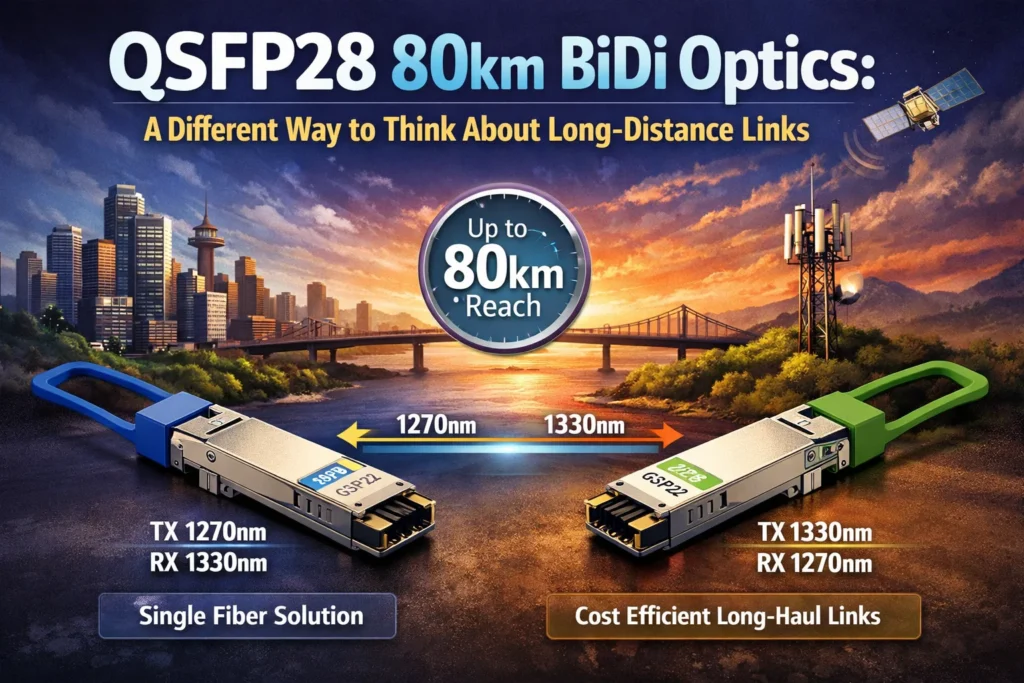
Instead of separating directions physically, it separates them by wavelength. One wavelength carries traffic in one direction, another carries it back, both traveling through the same single-mode fiber. On the receiving end, the module filters those wavelengths apart again.
From the outside, nothing looks different. The switch still sees a normal 100G interface. Configuration doesn’t change. The link comes up the same way it always does.
But physically, you’ve just cut fiber usage in half.
And in fiber-limited environments, that’s not a small improvement.
What 80km Reach Actually Means in Practice
The “80km” number sounds like a hard limit, but in real networks it’s more like a comfortable upper range.
Most deployments don’t run right at the edge. Links might be 40km, 60km, or sometimes closer to the maximum. That still covers a wide range of scenarios connections between data centers in the same metro area, links between regional facilities, or infrastructure that spans industrial zones.
At these distances, signal quality becomes more sensitive to loss. Every connector, every splice, every patch panel adds a bit of attenuation. Over short distances, you barely notice. Over tens of kilometers, it starts to matter.
That’s why these modules are built with stronger optical budgets and more precise components. They’re designed to handle those accumulated losses without requiring additional amplification in most cases.
Still, the link has to be clean. Good fiber, proper installation it all adds up.
Deployment Feels Simpler Than It Probably Should
What’s interesting about QSFP28 80km BiDi modules is how simple they feel to deploy, considering what they actually do.
You’re setting up a 100G link across dozens of kilometers, possibly between different facilities, and yet the process doesn’t feel very different from plugging in a short-range module.
Insert the module, connect the fiber, check the interface.
That’s about it.
There’s no separate transport system, no external wavelength management, no extra boxes sitting in between. Everything is contained in the module itself.
For teams used to standard Ethernet optics, this familiarity reduces friction. You don’t need a completely different skill set just to handle long-distance links.
It just extends what you already know.
Where These Modules Actually Get Used
In real-world deployments, these modules tend to show up in places where infrastructure constraints are already part of the conversation.
Metro data center interconnect is a common one. Companies running multiple sites across a city need reliable, high-bandwidth links between them. Fiber routes exist, but not always in abundance.
BiDi modules let them increase capacity without doubling fiber usage.
Telecom environments also use them for aggregation links, where traffic from multiple access points converges and needs to be transported efficiently over longer distances.
There’s also a growing presence in edge computing setups. Smaller facilities positioned closer to users still need strong connections back to central data centers. These links aren’t always extremely long, but they’re long enough to require something beyond standard LR optics.
In all these cases, the pattern is similar distance matters, but fiber availability matters just as much.
Things That Don’t Show Up Until Later
On paper, everything about BiDi optics looks clean. In practice, there are a few details that only become noticeable over time.
One is sensitivity to link conditions. Because transmit and receive share the same fiber, any issue along that path affects both directions. Troubleshooting can feel slightly different compared to duplex links where each direction is isolated.
Another is planning. You can’t mix wavelengths randomly. Each side of the link needs to match properly, or the connection simply won’t work. It’s not complicated, but it does require attention.
And then there’s cost. These modules aren’t cheap. But when you compare that cost to laying new fiber or deploying additional infrastructure, the trade-off often makes sense.
It’s less about the price of the module itself and more about what it replaces.
Why This Approach Keeps Showing Up
As networks continue to expand, physical constraints don’t go away. If anything, they become more noticeable. Space, power, fiber availability these are all limits that technology has to work around.
QSFP28 80km BiDi modules are one way of doing that.
They don’t try to be the most flexible or the most advanced solution. Instead, they focus on a very specific problem: how to deliver high bandwidth over long distances without requiring more fiber.
And for that problem, they work surprisingly well.
Conclusion
QSFP28 80km BiDi optical modules offer a practical approach to long-distance networking by combining high bandwidth with efficient fiber usage. By enabling bidirectional transmission over a single strand of single-mode fiber, they help networks expand capacity even when infrastructure is limited. Their straightforward deployment and compatibility with standard Ethernet systems make them accessible, while their long reach supports a wide range of real-world scenarios. In environments where both distance and fiber constraints matter, BiDi optics provide a solution that feels simple, but solves a very real problem.