
Introduction
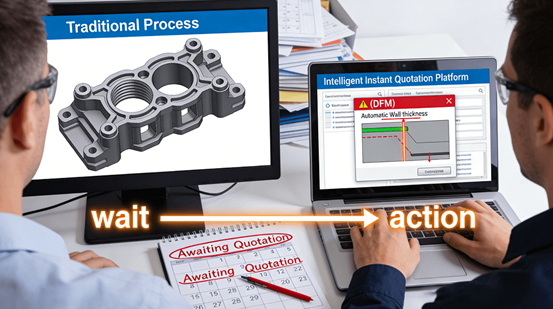
Hardware teams are stuck in a crippling “waiting game” that stalls them right at the starting line of new product development. After sending out design files, weeks of silence ensue, or a supplier sends back a gross estimate that is impossible to compare. This creates a paralysis of sorts, stuck in an information void, where market opportunities are slipping away while we wait. In fact, up to 40% of prototyping delays are caused by an inefficient, fragmented process of request for quote and supplier alignment, according to various studies.
The problem is that the traditional “design-quote-feedback” process is a linear, non-integrated process. Design intent and manufacturing knowledge are two separate silos. The engineer designs in a vacuum; the supplier must guess based upon limited data availability. The result is an infinite loop of clarification requests, last-minute manufacturability warnings, and cost estimates that are full of unforeseen risks. In this article, we will show you how a new paradigm of instant, intelligent quoting coupled with DFM analysis rebuilds this flawed process into a parallel data-driven collaborative loop that eliminates up to 80% of pre-prototype delays.
What’s the Difference Between a “Fast Guess” and a “Smart, Instant Quote?”
The ultimate answer is that a smart instant quote is a shift from art to a data-driven science. This is because a smart instant quote is essentially a transparent cost model based on empirical machining physics, not art. This is how instant trust is built and a fundamental understanding is achieved from the start.
1. The Anatomy of an Algorithmic Quote
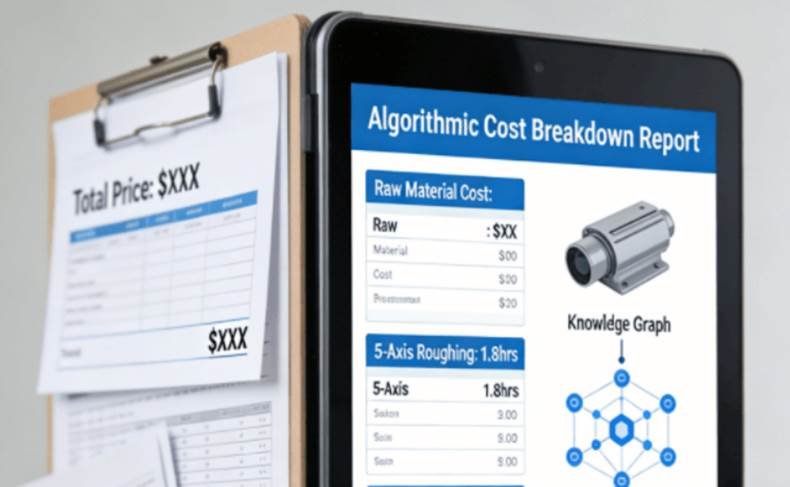
As the system calculates the part being analyzed, it undertakes an intricate calculation. To start with, it identifies the essential geometry and manufacturing steps that need to be taken. Subsequently, it undertakes the simulation of the toolpaths and the kinematics of the machines. Finally, it takes into consideration the material costs and the logic of the secondary steps. Thus, the quote is not merely an algorithmic output but an understandable and itemized cost calculation that justifies the “reasons behind the quote,” which immediately creates trust.
2. From Data to Decision: The Role of the Knowledge Graph
The basis of this “intelligence” is a manufacturing ontology that is capable of learning, a knowledge graph that connects design elements like a hole with a depth-to-diameter ratio of 10:1 with the best machining strategies and historical tool performance data. This system aligns with the principles supported by the National Institute of Standards and Technology (NIST) and their encouragement of data-driven manufacturing and intelligent optimization of processes. If a user submits a part for a price, the system refers to a database of similar features, using the uniform data frameworks promoted by NIST, and comes up with an accurate and reliable price.
3. The Tangible Output: Clarity Over Mystery
The end result is a quote that is an instant manufacturing advisory report. Instead of a mysterious figure for the total price, you get a breakdown by the cost per blank, programming time, time per operation for each piece of machinery used (e.g., “5 axis roughing: 1.8 hrs”), and anodizing costs, etc. This level of detail, provided in a matter of minutes, demystifies the manufacturing process and allows engineers to make informed decisions about trade-offs from the very start.
How Does “Front-Loaded” DFM Make Costly Late-Stage Changes into Free, Early Conversations?
By making DFM a timely, natural conversation starter, this approach turns traditional costly problem discovery upside down. It also enables designers to think from a manufacturing-centric point of view from the beginning, which encourages a collaborative optimization process. This approach eliminates costly physical changes, significantly de-risks the manufacturing process, and maximizes the chances of a successful first article.
- Simulating Manufacturing Constraints in Real-Time: The analysis process itself is a simulation of a virtual manufacturing review. It uses rules and heuristics based on thousands of completed projects. For instance, it could figure out the realistic minimum thickness for a wall given the material and shape or even detect the parts that would need complicated tool paths or custom fixturing for the undercuts. It brings these limitations to the surface instantly, allowing the designer a manufacturing viewpoint that is typically only possible after weeks of cooperation with a sales engineer.
- The Collaborative Optimization Loop: It changes the process from a linear one of “handoff” between people or systems to a true collaboration. A designer might make incremental changes to a design perhaps a slightly increased radius on a fillet or a change in a draft angle only to see the impact of those changes on the quote in an instant. It creates a dynamic what-if analysis environment in which the costs and manufacturability of a part are dynamic design parameters. The process changes from “Does it work?” to “How do we make it work?” in a true concurrent engineering environment.
- Quantifying the Prevented Cost: The value of this front-loaded DFM is directly measurable by quantifying the cost savings from avoided scrap, tool changes, and schedule savings. The recommendation to increase a corner radius by a single unit could save a broken tool and hours of machine downtime. The warning about a non-standard thread size could save a costly custom tool order. By solving these problems electronically, we greatly de-risk the physical production process, ensuring that the first article is a success instead of a failure, which could cost hundreds of thousands of dollars in physical prototype iterations.
Can You Really Compare Quotes from Different Suppliers in an “Apples-to-Apples” Way?
A smart, instant quote helps to clarify any confusion that might arise by forcing the supplier to follow a structured and transparent cost structure. This way, the comparison of the underlying manufacturing logic and value is possible rather than just the mysterious total price.
1. Deconstructing the Quote: From Black Box to Open Book
With the transparency of the quote, it becomes possible to audit the manufacturing strategy. Does the supplier of the part propose an efficient 3+2 machining strategy, while the other assumes full 5-axis? Does the surface finishing and inspection procedure follow the same procedure? This transparency allows for better questions and comprehension of the fact that the supplier might be offering the part at a cheaper price because of an efficient strategy or because they might be omitting an important quality control procedure. This transparency changes the entire nature of the procurement dialogue from price negotiations to value and process engineering.
2. The Foundation for Trust and Partnership
This level of detail and transparency in the quoting procedure creates an instant sense of trust and credibility. It shows that the supplier has already audited the part and is confident about the strategy they propose. This creates an environment of mutual understanding and expectations between the two parties before the project begins. There is no room for the “scope creep” and additional charges that might be incurred in the project. A transparent quote is the beginning of an efficient and professional partnership.
3. Making Value-Driven Decisions
When each quote is analyzed to its core components, you are in a position to make strategic decisions. For example, Supplier A may be more expensive in machine time, but they also offer a comprehensive CMM inspection report, which is vital for your medical device. On the other hand, Supplier B may be cheaper, but they also do not offer post-processing. This allows you to pay for the value you receive. However, in order to get the most out of this, it is vital to find a supplier who is capable of delivering end-to-end. For a comprehensive understanding of how to get the most out of this synergy, a resource on the process of obtaining instant CNC machining quotes with free DFM is a vital resource.
What’s the “Real” Lead Time? From Quote Confirmation to Parts in Hand.
The integrated model creates a new definition of lead time by significantly condensing the pre-production time from weeks to hours. This creates a breakthrough by unlocking engineering time and enabling true agile hardware development by speeding up the exploration of designs. The emphasis is no longer on the speed of the machines but on the entire development process.
1. The Hidden Cost of the “Quoting Queue”
The quoting queue is a major drag on overall productivity. Engineers sit around twiddling their thumbs awaiting feedback on whether or not a design is possible or cost-effective. Project management is impossible. As such, there is a project management bottleneck that prevents agility from being achieved. With immediate feedback, however, this stalled time is eliminated, and the entire team is able to stay on a fast track to project completion without any delays or issues.
2. Enabling True Agile Hardware Development
This is the speed that is achieved in the initial phase. This is the cornerstone of hardware development. With this speed, you are able to explore multiple design alternatives. For instance, you can upload different versions of a component or a part. With this speed, you are able to understand within a day the cost implications of each variation. This allows you to do parallel prototyping. As such, you are able to physically prototype multiple design directions simultaneously based on actual data.
3. Predictability as a Competitive Advantage
The greatest value of a compressed and predictable pre-production phase will be predictability in the project schedule. Knowing a firm quote and DFM analysis are available within a day means a company can commit to internal deadlines and customer deliveries with complete assurance. This predictability in the critical path of product development will prove a major competitive advantage as companies are able to get their products to market sooner with more assurance than their competitors are able to achieve in the old paradigm of waiting and guessing.
Beyond Speed: How Does This Model De-Risk Your Project from Start to Finish?
The fundamental value of the model is to enable risk management comprehensively in your projectfrom the idea stage to the final productthrough three major factors: cost, quality, and lead time. Just serving as “risk radar, ” it makes “unknown unknowns” become well-defined and manageable issues. With this ability, apart from building a strong and reliable base during the prototype phase, it also leads to a smooth scaling up of production. The approach is just the kind of advanced manufacturing that the Society of Manufacturing Engineers (SME) has been promoting through systematic engineering collaboration and data-driven approaches that make manufacturing processes predictable and optimizable, thus taking traditional supplier relationships to real engineering partnerships.
- Eliminating the “Unknown Unknowns”: The biggest risks are always the “unknown unknowns” the things we are not even aware we are risking. The traditional approach is a fertile ground for such unknowns. The integrated approach is like a risk radar system that scans the digital design for hundreds of potential manufacturing, cost, and schedule-related gotchas before they become actual project crises. The vague and potential risk is now a clear and defined problem that is solvable while there is still maximum flexibility to fix it at a minimum cost.
- Building a Foundation for Scalability: This de-risking is not limited to a prototype. The manufacturing process validation that is conducted during the instant quoting and DFM phase is like creating a blueprint for manufacturing. The design is now optimized, toolpaths are defined, and a cost model is now correct. The project has now gone from a prototype to manufacturing seamlessly because it was done correctly from the very beginning.
- Fostering Strategic Partnerships: Typically, this model revolutionizes the client-supplier dynamic from a “send and buy” arrangement to a full engineering partnership. During the discussion of the engineering aspects of the product from the very first minute, the two sides get to collaborate to devise the optimal product through the most efficient method. The whole process of going from a digital file to making a physical product, brought about by openness and data-sharing, is what allows us to jointly overcome the ever-more-complex manufacturing enviornment, as a genuine part of your engineering team.
Conclusion
Being able to bring a product to market quickly is a big edge over competitors these days. Long, obscure quoting procedures and unexpected problems in manufacturing at the last minute can turn a company into a risky one from a strategic point of view. The move to automated, smart quoting with built-in design-for-manufacturability (DFM) analysis for customized CNC machining parts is a radical transformation for them, dramatically increasing the quality of their products and responsiveness to market needs. This transition is equivalent to getting rid of time-consuming multiple iterations and delays by parallel work and replacing problem solving after problems have occurred with manageable risks before issues arise through proper analysis and planning. Hardware teams implementing this method will not only be able to shorten their cycles and manage their budgets accurately but they will also be able to lead the projects step-by-step from idea to execution with assurance. Consequently, this is not only about creating prototypes rapidly, but it is also about having a leaner, more productive and more innovative product development process giving a competitive advantage that is maintained.
FAQs
Q: What is the accuracy of the “instant” CNC machining quotes produced by the algorithm compared with traditional manual quotes?
A: For designs with standard geometries, algorithmic quotes are very accurate, with a typical accuracy of within 5-10% of the final cost, as it is based on huge datasets of real-world machining data. The system will identify unusual features for further analysis by an engineer, thus providing a very accurate result.
Q: What information do I need to upload for the best instant CNC machining quote and feedback?
A: The best file format is a 3D CAD file, preferably STEP or IGES. Providing information about the material and the quantity is necessary. Adding information about the function of the part and any important features will give better feedback from the DFM analysis. A 2D drawing with important tolerances highlighted will further enhance the value of the feedback.
Q: Is this service good for both one-off prototypes and production runs?
A: Absolutely! The quote engine is based on your volume, so it’s good for pricing anything from a one-off prototype all the way through a production run. The DFM feedback is universally useful, so it’s good for any production volume, preventing problems down the line.
Q: What is the format of the free DFM feedback, and what information is typically included?
A: A structured digital document, such as a PDF, is sent with visual callouts on your 3D model pointing out areas of concern, as well as explanations and design recommendations for improvement.
Q: What if the design is very complex and the system cannot generate a quote?
A: If the design is very complex, it will be automatically identified and reviewed by senior manufacturing engineers. However, you will receive a rapid response, often in a matter of hours, to let you know a specialist is reviewing the design to offer the most accurate advice.
H3: Author Bio
The data cited in this article is derived from LS Manufacturing’s extensive practical experience in the fields of digital precision manufacturing and agile supply chain solutions. As a certified manufacturing partner, they strictly adhere to international standards such as ISO 9001, IATF 16949, and AS9100D. Leveraging integrated smart quoting and engineering analysis tools, they empower innovators to bring their concepts to market rapidly and efficiently. If you wish to experience transparent, precise quoting services and obtain a professional DFM (Design for Manufacturability) analysis report for your project, we invite you to up