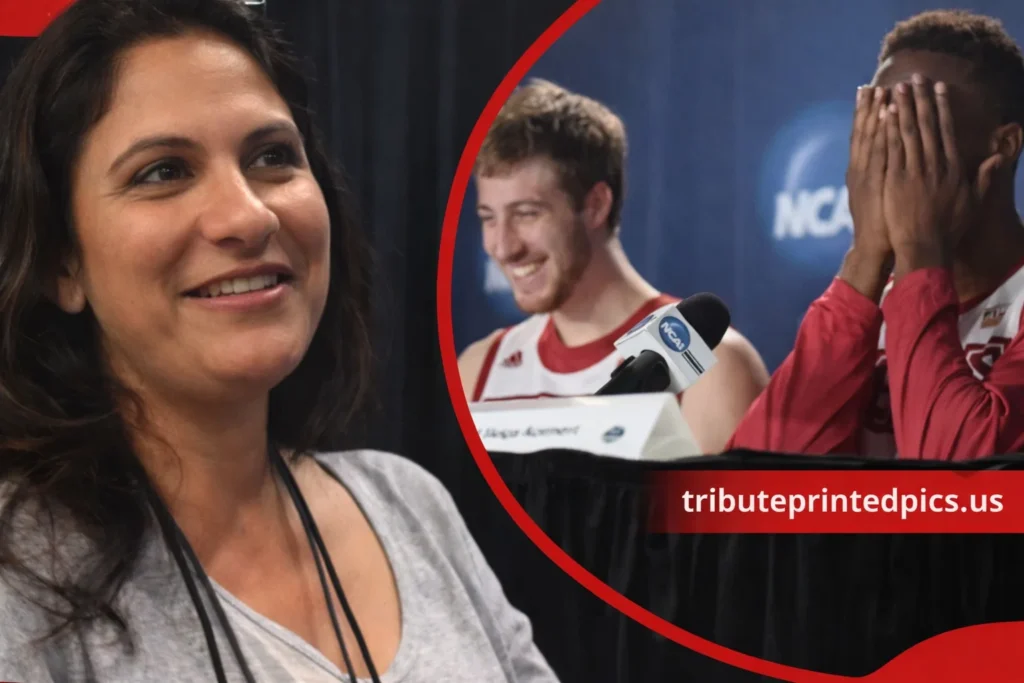

Introduction to Debra Bollman and Her Viral Moment
The story of Debra Bollman is unusual because it begins not with fame or media ambition but with quiet professional work behind the scenes. For many years she worked as a sports stenographer responsible for sports interview transcription during major athletic events. Her role required focus, discipline, and the ability to capture spoken words at incredible speed. Most people attending a sports press conference never notice the transcription specialist sitting nearby with a stenotype machine. However, in one unforgettable moment during an NCAA press conference, that quiet role became the center of a global conversation.
During a widely watched NCAA basketball tournament media session, Wisconsin Badgers player Nigel Hayes made a private remark that accidentally went public because of a hot mic comment. The basketball player compliment directed toward the stenographer was respectful but unexpected, and the microphone slip-up incident created a humorous situation that viewers immediately noticed. Within hours the internet viral clip began spreading rapidly on social media platforms, transforming an ordinary press conference moment into a social media viral moment. The viral stenographer suddenly became the subject of news stories, interviews, and public curiosity. That professional was Debra Bollman, an American stenographer working with the sports transcription company ASAP Sports.
The sudden attention created unexpected viral fame for someone whose work usually happens quietly in the background. Television programs such as Fox Sports, Inside Edition, and Extra TV discussed the incident and introduced viewers to the fascinating world of sports media transcription. The event not only highlighted the professionalism of Debra Bollman but also sparked curiosity about the court reporting profession and the complex skills required for real-time captioning services.
Here is a Quick Bio table for Debra Bollman:
| Full Name | Debra Bollman |
|---|---|
| Known As | Debra Bollman |
| Profession | Sports stenographer, court reporter, real-time captioner |
| Nationality | American |
| Industry | Court reporting and sports media transcription |
| Education | California School of Court Reporting |
| Workplace / Organization | ASAP Sports |
| Professional Associations | National Court Reporters Association, California Court Reporters Association |
| Residence | Riverside California, Norco California |
| Known For | Viral NCAA press conference moment |
| Viral Event | NCAA press conference during NCAA basketball tournament |
| Related Athlete | Nigel Hayes |
| Team Mentioned | Wisconsin Badgers |
| Career Role | Sports press conference transcription and sports journalism transcription |
| Skills | Professional stenography, real-time transcription services, live event stenography |
| Typing Ability | Professional typing speed, capable of typing 300 words per minute |
| Partner / Relationship | Antony Farfan |
| Children | Sophia Bollman, Saylor Bollman, Simeon Bollman |
| Media Coverage | Fox Sports, Inside Edition, Extra TV |
| Specialty Work | Sports interview transcription, sports event captioning, sports broadcast captioning |
| Career Field | Court reporting profession and transcription specialist work |
| Public Recognition | Internet viral clip and social media viral moment |
| Notable Incident | Microphone slip-up incident during NCAA media session |
Early Life and Background of Debra Bollman
Long before the viral NCAA moment brought public attention to her work, Debra Bollman lived a life shaped by discipline and dedication to a specialized profession. She spent much of her life in California, particularly in communities around Riverside California and Norco California. These locations played a meaningful role in her personal and professional development because they provided the environment where she built the skills that would eventually support her career as a court reporter and transcription specialist.
Growing up in this region allowed her to experience the balance between community life and professional ambition. While many young people choose careers that involve public recognition, Bollman focused on a profession that required patience, attention to detail, and constant practice. The path toward becoming a real-time captioner is not easy. Students must learn complex shorthand systems and train their minds to process spoken language instantly. For someone interested in communication, language, and precision, the field of professional stenography offers a unique challenge.
The early influences in Bollman’s life helped shape her commitment to accuracy and professionalism. These qualities would later become essential when she entered environments such as NCAA media sessions where reporters, athletes, and coaches speak quickly and sometimes simultaneously. The ability to remain calm in fast-paced situations is one of the defining traits of successful court reporters. Debra Bollman developed those qualities long before the world noticed her presence at a basketball press conference moment that would become widely shared online.
Education and Training at the California School of Court Reporting
The journey toward becoming a professional stenographer begins with specialized education, and Debra Bollman pursued that training at the California School of Court Reporting. This institution is known for preparing students to enter the demanding court reporting profession. The program teaches the use of stenotype machines, shorthand theory, and real-time reporting technology. Students must train extensively to reach professional typing speed while maintaining exceptional accuracy.
Learning stenography is very different from traditional typing. Instead of pressing individual letters on a keyboard, stenographers press multiple keys simultaneously to form sounds or syllables. This method allows skilled professionals to reach speeds that often exceed typing 300 words per minute. Such speed is essential for producing real-time transcription services during live events. If a stenographer falls behind, the accuracy of the transcript may suffer, so students spend years practicing until their reflexes and listening abilities operate almost automatically.
At the California School of Court Reporting, students also study language patterns, punctuation techniques, and the editing process used to convert shorthand into readable transcripts. This knowledge prepares them for careers in courts, government agencies, and media environments. During her training, Debra Bollman also became familiar with professional organizations such as the National Court Reporters Association and the California Court Reporters Association. These groups support the development of court reporters and promote professional standards across the industry.
The education she received provided the foundation for a successful career in transcription. After completing her training, Bollman entered a field that required constant concentration and precision. Her expertise would eventually place her inside rooms where major sporting events were discussed by athletes and journalists.
The Demanding Career of a Sports Stenographer
Working as a sports stenographer involves far more than simply typing spoken words. Professionals in this field must capture every sentence spoken during interviews, press conferences, and media sessions. Debra Bollman became part of a network of transcription specialists who support sports journalism by providing accurate transcripts quickly after events conclude. These transcripts help journalists confirm quotes, write articles, and produce broadcast segments.
In sports environments the pace of conversation can be extremely fast. During a college basketball media day or postgame interview, several reporters may ask questions at once. Athletes may respond quickly, sometimes using slang or technical terms related to the sport. A stenographer must recognize these words instantly and translate them into written form while continuing to listen for the next sentence. This process requires extraordinary concentration and a high level of professional typing speed.
Bollman performed this work with the support of ASAP Sports, a company known for delivering sports press conference transcription and sports event captioning services. The organization specializes in sports journalism transcription and provides transcripts for many professional and college sporting events. Their work helps reporters access accurate information quickly, which improves the speed and quality of sports coverage.
Although spectators rarely notice the stenographer in the room, the role is essential. Without accurate transcription, media organizations would need to review long recordings before publishing quotes or analysis. By producing transcripts almost immediately after events conclude, professionals like Debra Bollman help maintain the efficiency of sports reporting.
The NCAA Press Conference That Changed Everything
The moment that introduced Debra Bollman to a global audience occurred during an NCAA press conference at the NCAA basketball tournament. Wisconsin Badgers star Nigel Hayes attended the media session as reporters gathered to ask questions about the team’s performance and upcoming games. As usual, a sports stenographer sat nearby capturing every word spoken during the interview.
While waiting for the next question, Hayes noticed the stenographer typing rapidly on her machine. Believing the microphone was turned off, he quietly told a teammate that the stenographer was beautiful. Unfortunately for him, the microphone was still active, and his comment was captured during the broadcast. The remark created a humorous press conference incident that viewers immediately noticed.
The moment was brief and harmless, but the microphone slip-up incident quickly became memorable. Within hours the clip began circulating online. Social media users shared the video widely, and many viewers found the situation charming rather than embarrassing. The interaction between the athlete and the stenographer appeared genuine and respectful, which helped the clip become an internet sensation moment.
At the center of the story was Debra Bollman, who continued typing calmly despite the unexpected attention. Her professional composure became part of the reason the moment resonated with viewers. Rather than reacting dramatically, she simply continued performing her duties as a transcription specialist.
Media Coverage and Public Reaction
As the internet viral clip gained popularity, major media outlets began discussing the story. Sports networks such as Fox Sports shared the clip with viewers and described the situation as one of the most amusing basketball press conference moments of the season. Entertainment programs such as Inside Edition and Extra TV also covered the event, introducing audiences to the concept of live event stenography.
The media coverage emphasized the lighthearted nature of the situation. Most viewers recognized that the basketball player compliment was not intended to cause embarrassment. Instead, it showed how easily a hot mic comment can turn an ordinary conversation into a widely shared moment. The story became an example of how modern media technology can capture spontaneous human interactions.
For Debra Bollman, the attention represented unexpected viral fame. She handled the situation with professionalism and humility. Instead of seeking publicity, she continued focusing on her work in real-time transcription services. Her calm response earned respect from journalists and viewers alike. Many people admired the way she maintained composure during the sudden wave of media interview attention.
Understanding the Role of a Court Reporter
The viral moment sparked curiosity about the court reporting profession. Many viewers had never considered how transcripts from press conferences were produced. A court reporter or sports stenographer plays a critical role in capturing spoken language accurately and efficiently. These professionals must listen carefully while typing at extraordinary speed.
Court reporters often work in environments where accuracy is essential. In legal settings transcripts become official records that may influence court decisions. In sports media transcripts help journalists verify quotes from athletes and coaches. The responsibility of capturing words exactly as they are spoken makes the profession both demanding and important.
The work performed by Debra Bollman demonstrates the complexity of professional stenography. It requires years of training and constant practice to maintain high levels of accuracy. The job also demands the ability to remain calm during unpredictable situations such as fast-paced interviews or crowded media sessions.
Technology Behind Real-Time Transcription
The technology used in stenography allows professionals to convert spoken language into written text almost instantly. Stenotype machines contain fewer keys than traditional keyboards but allow multiple keys to be pressed simultaneously. Each combination represents sounds or syllables rather than individual letters.
When a stenographer presses these keys, specialized software translates the shorthand into readable words. The system relies on dictionaries and editing tools that help convert shorthand patterns into complete sentences. This technology supports real-time reporting technology used in courts, television broadcasts, and public events.
Table: Basic Components of Stenography Technology
| Component | Purpose |
|---|---|
| Stenotype machine | Enables rapid shorthand typing |
| Transcription software | Converts shorthand into readable text |
| Captioning systems | Provide live captions during broadcasts |
| Editing tools | Refine transcripts for publication |
These tools allow professionals like Debra Bollman to deliver reliable transcripts almost immediately after a media session concludes.
Professional Skills Required for Stenographers
The court reporting profession demands a unique combination of skills. Listening ability is just as important as typing speed. Stenographers must recognize speech patterns, accents, and technical vocabulary while continuing to type without interruption. Maintaining concentration during long sessions can be challenging, especially when multiple speakers participate in the conversation.
Professional typing speed remains one of the most important abilities in the field. Achieving speeds close to typing 300 words per minute requires years of training and constant practice. Stenographers also develop strong editing skills so they can review transcripts quickly and correct any potential errors before publication.
Debra Bollman’s success demonstrates the level of dedication required to master these skills. Her experience in sports journalism transcription and live captioning services shows how valuable these abilities can be in fast-moving environments.
Personal Life and Family
Despite the attention created by the viral NCAA moment, Debra Bollman has maintained a private personal life. She has connections to Antony Farfan and family members including Sophia Bollman, Saylor Bollman, and Simeon Bollman. While the public became curious about her life after the internet sensation moment, she remained focused on her professional responsibilities.
Many individuals who experience sudden online fame choose to pursue media opportunities, but Bollman took a different path. She preferred to continue working quietly in the field she had chosen years earlier. This decision reflects the professionalism often associated with the court reporting career path.
Her dedication to both family and career illustrates how individuals can maintain balance even when unexpected attention arrives. The viral moment may have introduced her to millions of viewers, but it did not change the values that guided her life.
The Impact of the Viral NCAA Moment
The viral NCAA moment involving Debra Bollman had an interesting effect on public awareness of stenography. Before the event many sports fans had never considered the role of transcription specialists during press conferences. After the clip spread online, people began researching the profession and learning about the skills required to capture live speech.
Educational programs reported increased interest from students curious about the field. The court reporter career path suddenly appeared more visible to the public. In this way, the unexpected incident indirectly helped promote understanding of professional stenography and real-time captioning services.
Debra Bollman and Sports Media
Sports journalism depends heavily on accurate records of interviews and press conferences. Reporters must quote athletes precisely, and transcripts help them confirm the exact wording of statements. Without transcription specialists, journalists would spend hours reviewing recordings before publishing articles.
Professionals like Debra Bollman provide an essential service to sports media organizations. Their work ensures that information remains accurate and accessible. Even though they rarely appear on camera, stenographers contribute to the reliability of sports reporting.
The Growing Demand for Captioning Services
Modern communication increasingly relies on real-time captioning services. Television broadcasts, online streams, and public conferences now use captioning to make content accessible to larger audiences. This demand has expanded opportunities for professionals trained in stenography.
Real-time transcription services now support many industries beyond sports and legal environments. Government meetings, corporate conferences, and educational programs often rely on captioning specialists. The skills developed by professionals like Debra Bollman remain valuable as communication technology continues to evolve.
Lessons From the Viral Press Conference Moment
The press conference incident involving Nigel Hayes and Debra Bollman illustrates how unpredictable live media environments can be. Microphones sometimes remain active when participants believe they are off, creating situations where private remarks become public. In this case the moment remained harmless and humorous.
The event also demonstrated how authenticity can capture public attention. The genuine reaction of the athlete and the calm professionalism of the stenographer created a memorable moment that resonated with viewers. It became a reminder that real people exist behind the scenes of major sporting events.
Conclusion
The story of Debra Bollman demonstrates how a quiet professional career can unexpectedly intersect with global media attention. Her role as a sports stenographer placed her in the room during an NCAA press conference that produced one of the most memorable viral moments in college basketball media history. While the comment from Nigel Hayes created humor and curiosity, the real lesson comes from Bollman’s professionalism and dedication to her craft.
The court reporting profession requires extraordinary skill, discipline, and attention to detail. Through years of training and experience, Debra Bollman developed the abilities necessary to capture speech with remarkable accuracy. The viral moment simply gave the public an opportunity to notice the essential work performed by transcription specialists behind the scenes of sports media.
Even after the internet sensation moment faded, the importance of her profession remained clear. Journalists, broadcasters, and researchers continue to rely on transcripts produced by skilled stenographers. The story reminds us that many professionals contribute to the media we consume every day, even if their names rarely appear in headlines.
Frequently Asked Questions
Who is Debra Bollman
Debra Bollman is an American stenographer and court reporter known for working with ASAP Sports and becoming widely recognized after a viral NCAA press conference moment.
Why did the Debra Bollman moment go viral
The moment became famous when Wisconsin Badgers player Nigel Hayes made a hot mic comment during an NCAA basketball tournament media session.
What does a sports stenographer do
A sports stenographer records spoken conversations during interviews and press conferences and produces accurate transcripts in real time.
Where did Debra Bollman study stenography
She studied at the California School of Court Reporting, where students learn professional stenography and transcription skills.
What organizations support court reporters
Professional groups such as the National Court Reporters Association and the California Court Reporters Association support the development of stenographers.