
Introduction
The industrial print sector is constantly faced with an essential challenge that arises from the inevitable deterioration of critical metal parts such as cylinders, guide rails, and nozzle plates due to the intense and continuous nature of the printing environment. This situation inevitably compromises the quality of print output and increases the cost of maintenance. The main cause of the deterioration of print parts is the inability of the common machining techniques to attain the perfect harmony between the intricate shapes and micron tolerances that are essential for the production of print parts. This situation inevitably compromises the parts to the extent that they cannot withstand the ultra-stringent requirements of modern printing technology.
This article will highlight the various ways in which Precision CNC Milling technology is transforming the situation and providing the essential solutions to the challenges that have been affecting the print industry. The following sections will highlight the five ways in which the advanced manufacturing technology is transforming the reliability of print equipment.
How Does Precision CNC Milling Fundamentally Enhance the Accuracy and Durability of Printing Press Cylinders?
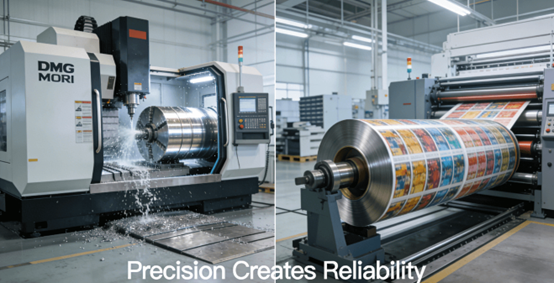
The geometric accuracy of a printing press cylinder, in terms of roundness and concentricity, is the absolute foundation of print registration accuracy and image consistency. Any inaccuracies in these areas, even in microns, can cause problems of ghosting, banding, and color consistency, making the prints unacceptable.
The Limitations of Conventional Manufacturing Processes
Classic turning and grinding operations may be able to provide a certain level of cylindricity in a cylinder. However, with modern composite cylinders with internal cooling channels, unusual end geometries, or lightweight designs, these methods are found wanting. These processes may involve multiple setups and operations, leading to cumulative errors. Moreover, these processes are not suitable for machining complex internal geometries, which limits the thermal management and dynamic balancing of the cylinders and hence their performance and useful life.
The Multi-Axis Machining Advantage – Unmatched Tolerances
The multi-axis precision CNC milling machine provides a paradigm shift in machine tool technology. It can perform the entire cylinder, including the outer diameter, faces, keyways, and intricate internal channels in a single setup. This ensures unmatched tolerances of ±0.005mm and superior surface finishes with a value of less than 0.4µm.
Engineering Longevity through Advanced Geometries
- Complex Internal Flow Paths:
This technology allows for the machining of complex internal channels or paths in the part. These may be either helical or chambered in nature. This geometry helps in improving the dissipation of heat from the part, effectively counteracting distortion. - Material and Surface Integrity:
High-quality tooling and precise machining parameters ensure the metallurgical integrity of the material near the surface. Roundness and concentricity of the part drastically reduce the amount of vibration at high speeds.
Therefore, during long, high-duty cycles, typical in Industrial Print Applications, the cylinder retains its stability, greatly extending the periods between maintenance. Research, such as that referenced by the Internatioal Manufacturing Engineering Society (SME), has shown that increasing the initial accuracy of a component may multiply its fatigue life by a factor. For a full understanding of this enabling technology, a detailed resource is available. Take a look at the full guide to Precision CNC Milling.
How Do Customized CNC Machined Parts Optimize Efficiency for Specific Printing Processes?
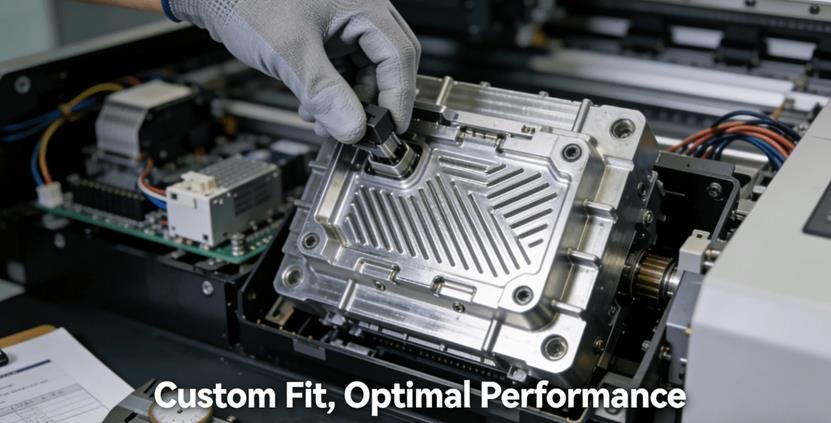
Various printing technologies have different requirements for their major parts. Custom Machined Parts, designed to meet these particular requirements, are a major contributing factor to the success of the entire Printing Process Optimization.
Addressing the Demands of Diverse Printing Technologies
Offset printing needs custom parts for its inking system as well as its dampening system. Digital inkjet printing needs nozzle plates that are highly resistant to corrosion. Flexographic printing needs anilox rolls as well as plate cylinders that are long-lasting. These are just a few examples of printing technologies that require custom parts for proper functioning. Standard parts are not able to meet these requirements; as a result, assembly is complicated, and debugging is time-consuming.
Case Studies in Customization for Enhanced Performance
- Non-Standard Substrate Handling:
In order to handle non-standard materials, manufacturers can use Custom CNC Milling services to produce rollers that have non-standard surface profiles. Paper jams are avoided by using such rollers. - Optimized Fluid and Curing Systems:
Customized ink delivery systems and/or UV curing systems may be provided with customized housing, manifolds, and mounting plates machined to ensure precise component alignment, thus optimizing system efficiency, consistency, and energy consumption.
Driving Measurable Gains in Overall Equipment Effectiveness (OEE)
The immediate benefit of such deep customization is the reduced machine commissioning times, setup waste, and run stability. This is particularly true in the event of a perfect match between the part system and the machine system, thus preventing unwanted down times and performance variability owing to mismatched components. This, in turn, directly improves other vital parameters such as Overall Equipment Efficiency. These precision CNC Milling parts facilities are particularly geared for such high-demand, highly customized productions.
What Solutions Do Precision CNC Machining Services Offer for Complex Printing Molds and Fixtures?
In print finishing, the quality of high-precision dies in embossing, foil stamping, and die-cutting, and special jigs in supporting irregular materials, has a significant impact on decorative outcomes and production efficiency. These dies and jigs require extreme geometric complexity, dimensional stability, and wear resistance.
In print finishing, perfect and flawless dies and cutting tools, and special fixtures, play an important role in production. These dies and cutting tools require extreme geometric complexity, dimensional stability, and wear resistance. Advanced 5-axis Precision CNC Machining Services can efficiently create intricate 3D shapes in a single setup, avoiding any possibility of error. For mass production, following strict standards like ISO 9001 and IATF 16949 ensures that every tool produced meets high standards, from material certification to CMM inspection, so that every tool produced is identical. This links intricate tool designs with robust and efficient industrial processes.
What Role Does CNC Milling for Prototypes Play in Developing Next-Generation Printing Equipment?
The race between printer equipment developers is, in its essence, a race to deliver speed from design to validation. CNC Milling for Prototypes is an indispensable accelerant in this race.
CNC Milling for Prototypes allows for a quick shift from CAD design to actual testing. Once a design is complete, CNC technology allows direct interpretation of 3D data to quickly produce a functional prototype from metal or engineering plastic within a matter of days.
This is not a prototype, but a working component that accurately represents the desired mechanical, thermal, and fluid properties. It can be integrated into a test bed to validate its performance, integrity, and motion under actual or simulated conditions. This quick and tangible approach to iteration allows for defect recognition before costly changes in the production stage, greatly accelerating the production cycle for new printer equipment.
How Can the Adoption of Precision Parts Optimize the Total Cost of Ownership (TCO) in Industrial Print Applications?
In considering procurement options for Industrial Print Applications, it is a short-sighted approach to consider only the initial cost of a component. The actual cost savings come from optimizing the total cost of ownership over the entire life of a component.
In considering parts for Industrial Print Applications, while it is true that the initial cost of a part is only a single factor, it is also true that low-quality parts result in a myriad of costly problems: vibration-related defects, unplanned downtime, and decreased productivity that far exceed the cost of a part. In contrast, a long-term strategy of using high-precision, long-lasting Custom Machined Parts is a sound approach. Not only are Custom Machined Parts more accurate, thus minimizing waste while ensuring quality products, but they are also longer-lasting, thus extending maintenance cycles to maximize uptime. The compelling case for Total Cost of Ownership (TCO) is underwritten by manufacturing to extremely stringent standards like AS9100D that ensure a long life of reliable performance.
Conclusion
In brief, precision CNC milling has evolved beyond its status as a simple manufacturing aid to its status as a fundamental technology driving the efficiency, reliability, and reduced costs of industrial printing. From the ultimate precision required in cylinders to deep customization of parts, from complex die and fixture work to speeding the validation process for prototypesits worth, best characterized by words such as “unparalleled” and “unmatched” for its accuracy, flexibility, and consistency, is being recognized and relied on by the world’s leading printing equipment manufacturers.
Is your printing equipment being held back by the quality of its components? Learn how to unlock the potential of precision manufacturing in your next project. Contact us today for a free Design for Manufacturability (DFM) analysis and discover how a customized solution can help take your equipment to the next level.
Author Bio
The author is an expert with over 15 years of experience in the field of precision manufacturing. His company, JS Precision, is a leading manufacturer offering end-to-end solutions to global companies in the manufacturing industry.
FAQ Section
Q: What are the main advantages of precision CNC milled parts over standard parts in printing applications?
A: Customization, micron-level precision, and high durability are the main advantages. These parts may be perfectly customized for specific applications, thus avoiding assembly problems, ensuring consistent quality in printing, and extending the life of vital parts with high-quality materials and processes.
Q: What is the typical lead time for custom CNC parts for a printing press?
A: Lead times vary according to the complexity and volume of the parts. If rapid CNC services are used, 3-7 business days may be required for delivery.
Q: What materials would be best for manufacturing highly wear-resistant printing press parts?
A: Tool steel, stainless steel 440C, alloy steel, and high-performance engineering plastic materials such as PEEK are some materials used for manufacturing highly wear-resistant parts. A detailed consideration of all factors, including weight and costs, is required.
Q: Can a CNC milling machine produce extremely precise anilox rolls for high-end color printing?
A: Yes. With ultra-precision CNC machine tools and diamond tooling, a CNC milling machine can machine the base roll of a ceramic or metal-coated roll with a complex and uniform cell structure, which is essential in precise ink transfer.
Q: How can I ensure precision parts outsourced meet the high standards of my company’s printing equipment?A: It is important to work with a supplier with quality system certifications such as ISO 9001 and request First Article Inspection reports, material certifications, and process quality controls. Clear drawings and tolerance specifications are also